How to Reduce Plagiarism in a PhD Thesis?
Pursuing a PhD is a long, rigorous, and rewarding journey, but one of the biggest challenges doctoral researchers face is ensuring their work is original. Plagiarism, whether intentional or accidental, can lead to serious academic consequences, including rejection of the thesis, reputational damage, or even expulsion. That’s why reducing plagiarism in a PhD thesis is not just important—it’s essential. Here’s a comprehensive guide to help you minimize plagiarism and maintain the academic integrity of your research.
1. Understand What Counts as Plagiarism
Before reducing plagiarism, it’s crucial to know what it actually means. Plagiarism is not just copy-pasting someone else’s text—it includes:
-
Direct Plagiarism: Copying text word-for-word without citation.
-
Self-Plagiarism: Reusing your previously published work without acknowledgment.
-
Mosaic Plagiarism: Borrowing ideas or phrases but changing a few words.
-
Accidental Plagiarism: Missing citations due to negligence or oversight.
Knowing these types helps you avoid mistakes that can be flagged by plagiarism checkers.
2. Use Proper Referencing and Citation
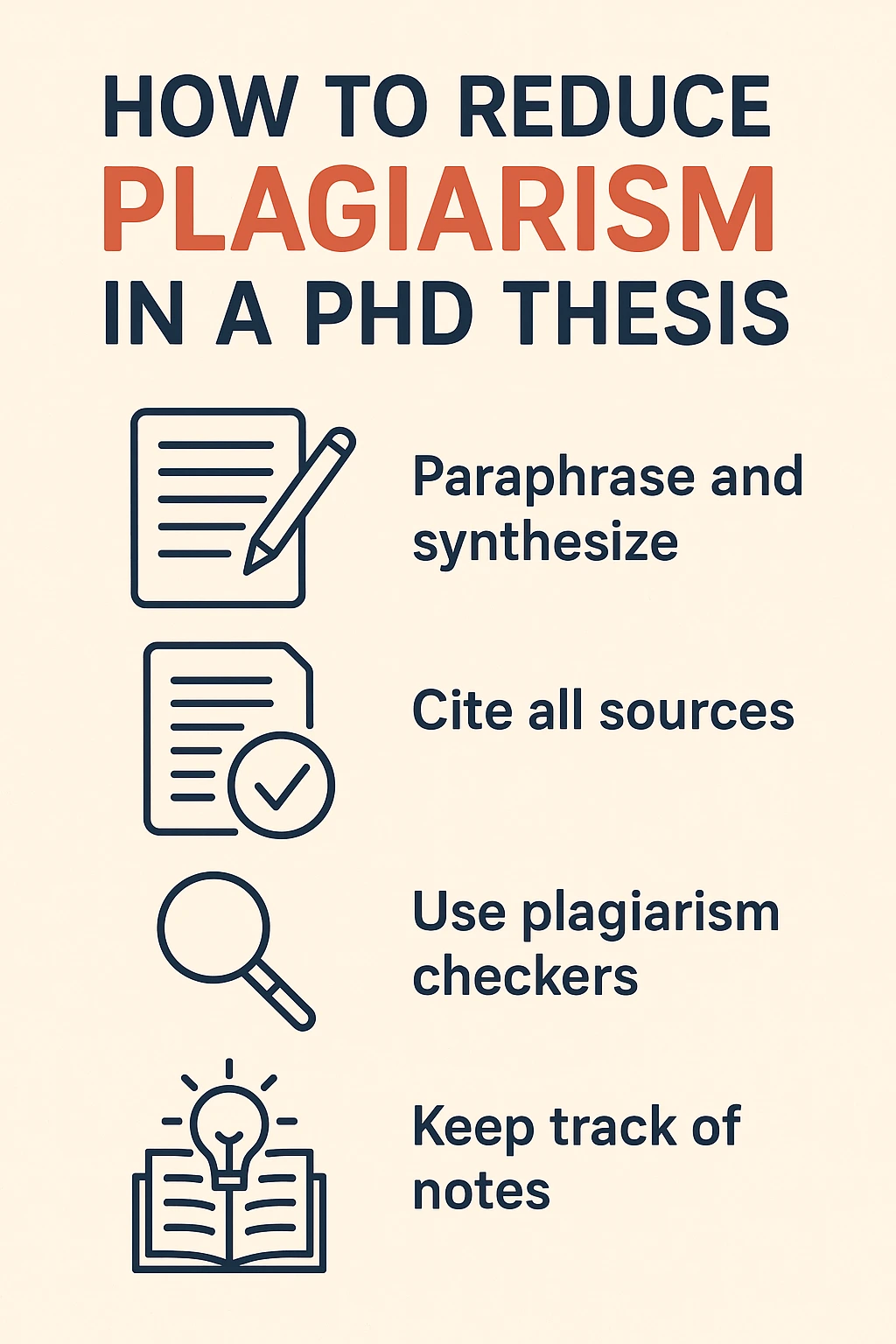
One of the most effective ways to reduce plagiarism is to give credit where it’s due. Follow the citation style required by your university (APA, MLA, Chicago, IEEE, or others). Always:
-
Cite direct quotations accurately.
-
Provide references for paraphrased ideas.
-
Include all sources in the bibliography.
3. Develop Strong Paraphrasing Skills
Paraphrasing doesn’t mean replacing a few words with synonyms. It means rewriting the idea in your own words while preserving the original meaning. To paraphrase effectively:
-
Read the source material thoroughly.
-
Close the book/article.
-
Rewrite the idea from memory.
-
Compare your version with the original to ensure accuracy.
4. Use Plagiarism Detection Tools
Before submitting your thesis, run it through plagiarism detection software. Some widely used tools include:
-
Turnitin
-
iThenticate
-
Grammarly Plagiarism Checker
-
Quetext
These tools help you identify unintentional overlaps with published material so you can fix them in advance.
5. Manage Your Sources Effectively
Keeping track of references is essential. Use reference management tools like:
-
Mendeley
-
Zotero
-
EndNote
These tools help organize citations, insert them automatically, and build bibliographies without errors.
6. Write More, Copy Less
A thesis is meant to showcase your contribution to knowledge. While referencing existing research is important, focus on:
-
Conducting original experiments or simulations.
-
Presenting unique case studies.
-
Offering new interpretations or frameworks.
The more original your research, the less likely plagiarism becomes an issue.
7. Quote Sparingly
Quotations should be used only when the original wording is crucial. Instead of filling your thesis with direct quotes:
-
Summarize ideas in your own words.
-
Use quotes only for definitions, technical terms, or impactful statements.
8. Check and Revise Carefully
Plagiarism often creeps in due to oversight. Revise each chapter carefully and double-check citations. Ask yourself:
-
Did I give credit for every borrowed idea?
-
Are paraphrased sections sufficiently rewritten?
-
Is my bibliography complete?
9. Seek Professional Help (If Needed)
If you’re unsure, consider academic writing support services. Professional editors can:
-
Check your thesis for plagiarism.
-
Improve paraphrasing and citations.
-
Ensure compliance with your university’s guidelines.
✅ Final Thoughts
Reducing plagiarism in a PhD thesis isn’t just about passing plagiarism checks—it’s about demonstrating integrity, originality, and contribution to knowledge. By citing correctly, paraphrasing effectively, managing sources, and focusing on your unique research, you’ll not only reduce plagiarism but also strengthen the credibility of your work.