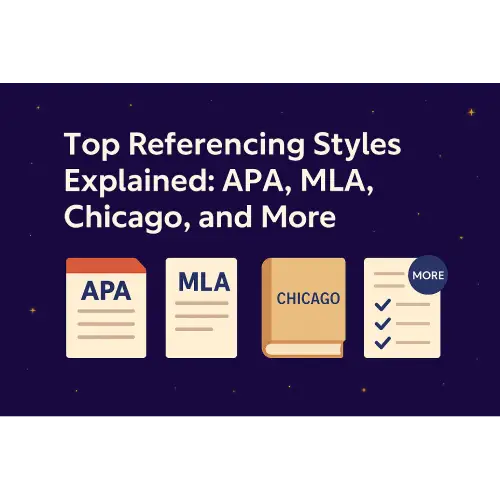
Every academic paper needs to be properly referenced, yet there are so many different citation formats that it can be confusing. Giving credit to the original authors and establishing the credibility of your work are just as important as adhering to the regulations when selecting the appropriate format. The most popular referencing styles and when to utilize them are broken out below.
The APA Style
Psychology, education, and the social sciences all make extensive use of APA, or American Psychological Association, style. Readers can immediately determine how recent the research is by focusing on the author and publication date.
Typical APA characteristics include
- Citations within the text that include the year and author name.
- An alphabetical reference list at the conclusion.
- A focus on writing that is concise and clear.
MLA Format
Papers in the humanities, arts, and literature frequently use MLA, or Modern Language Association, style. Since literary analysis frequently prioritizes the text itself over publication dates, it focuses on the author and page number rather than the date.
Typical MLA characteristics include
- citations within the text that include the page number and author name.
- An alphabetically arranged works cited page.
- Basic punctuation and formatting.
Chicago-style
Chicago style is well-liked in the fine arts, economics, and history. It gives writers options based on their subject matter by providing two systems: notes and bibliography and author date.
Typical characteristics of Chicago include
- Endnotes or footnotes for citations.
- A bibliographical page that includes complete source information.
- Depending on the discipline, there are two distinct formats.
Other Styles You Should Know
Depending on your field, you may also encounter IEEE style, which is widely used in engineering and technology papers, or Harvard style, which is typical in business and sciences. Although each style has its own set of guidelines for properly citing sources, the fundamental goal of avoiding plagiarism and providing due credit remains the same.
Which Style Is Best for You?
Since most institutions stipulate a necessary format, you should always verify your university's or journal's rules first. If you are not sure, Chicago and IEEE cater to more specific sectors, although APA and MLA are the most popular beginning points for students. The secret to a polished, expert outcome is to maintain consistency throughout your work once you are aware of the required style.