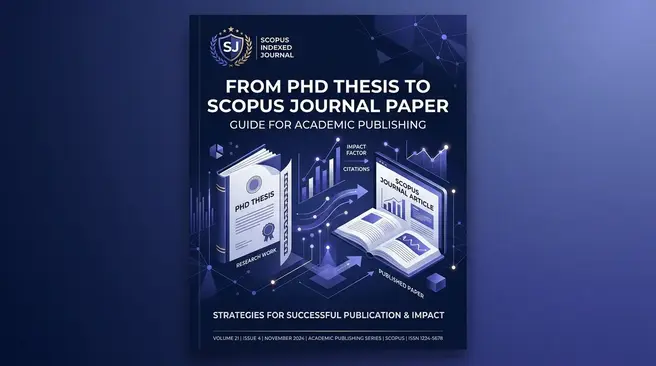
Every year, thousands of PhD scholars complete brilliant 200-page dissertations, only to encounter a wall of desk rejections when trying to publish in Scopus or Web of Science (WoS) indexed journals. University regulations increasingly demand peer-reviewed publications as a prerequisite for degree conferral or defense. However, submitting raw thesis chapters to journal editors is the fastest route to an immediate rejection letter.
A PhD thesis and a journal manuscript serve entirely different audiences and purposes. A dissertation demonstrates exhaustive research thoroughness to a university committee; a journal paper delivers a concise, novel contribution to busy peer reviewers and researchers.
This comprehensive guide outlines the exact 5-step framework to successfully condense, restructure, and publish your PhD thesis into a high-impact Scopus journal article.
1. Dissertation vs. Journal Article: Key Structural Differences
Before writing a single word, you must recognize why a direct "copy-paste" strategy fails. Journal editors read hundreds of submissions monthly and look for immediate markers of a raw thesis.
| Feature | PhD Dissertation | Scopus Journal Article |
|---|---|---|
| Target Audience | University Examination Committee | Global Academic Community & Peer Reviewers |
| Word Count | 40,000 – 80,000 words | 4,000 – 7,000 words |
| Literature Review | Exhaustive, historical coverage | Targeted focus on recent (last 3-5 years) gaps |
| Primary Goal | Proving scholarly competence | Communicating a single novel finding/insight |
| Tone & Format | Descriptive and highly detailed | Direct, analytical, and highly structured |
2. The "One Chapter, One Paper" Rule
Do not attempt to cram your entire 200-page thesis into one manuscript. Instead, apply the One Chapter, One Paper rule:
- Empirical Chapters: Transform each distinct quantitative or qualitative study chapter into an independent manuscript.
- Systematic Review Chapter: Rewrite a comprehensive literature review into a standalone PRISMA-guided systematic review or meta-analysis paper.
- Methodological Novelty: If you developed a custom framework, software model, or experimental setup, publish it separately as a methodology paper.
3. Step-by-Step Refactoring Framework
Step 1: Re-Anchor Title & Abstract
Dissertation titles tend to be overly descriptive and institutional. Journal titles must be concise, keyword-optimized, and outcome-oriented. Write a 200-250 word structured abstract highlighting the Background, Objective, Methodology, Key Results, and Implication.
Step 2: Drastically Compress the Literature Review
In a thesis, you might write 30-50 pages covering foundational background theories. In a Scopus manuscript, condense this to 800–1,200 words. Focus strictly on:
- What is currently known in the literature?
- What critical research gap remains unaddressed?
- How does your study explicitly solve this gap?
Step 3: Refine Methodology & Statistical Reporting
Peer reviewers scrutinize methodology above all else. Eliminate elementary explanations of standard tools. If you utilized complex statistical modeling (SEM, AMOS, PLS-SEM, Python/R routines), report parameters, validity metrics, and reliability coefficients concisely.
Need specialized assistance with data validation? Explore our dedicated SPSS Data Analysis Service.
Step 4: Sharpen Results & Isolate Key Findings
Select only 4 to 6 high-impact tables or figures that directly answer your core research question. Move secondary empirical tables or raw output data to an online Supplementary Material section.
Step 5: Write a Robust "Discussion" Section
The Discussion section is where most thesis conversions fail. Do not merely restate your results. Compare your findings against contemporary published studies in target Scopus/WoS journals. Highlight how your findings advance theoretical or practical understanding.
4. Avoiding Self-Plagiarism & Turnitin Traps
If your university uploaded your completed thesis to an institutional repository (e.g., Shodhganga, ProQuest, or university servers), automated plagiarism scanners like Turnitin will flag high similarity percentages.
- Paraphrase Thoroughly: Completely rewrite sentence structures, transitions, and explanations.
- Cite Your Thesis Correctly: Disclose in your manuscript submission cover letter that the study builds upon doctoral research, referencing the original institution where required.
- Scan Before Submission: Run your draft through institutional-grade tools to ensure similarity remains under 10%.
Check your manuscript similarity index with our Turnitin Plagiarism Removal Service.
5. Rejection-Proof Publication Checklist
- ☑
Scope Alignment:
- Is the manuscript tailored specifically to the target journal’s aims and scope? ☑
Word Count Target:
- Does the article adhere strictly to the target journal's maximum word limits? ☑
Reference Freshness:
- Are at least 70% of cited references published within the last 3-5 years? ☑
Formatting & Style:
- Are citations, references, and headings structured in exact APA/IEEE/Springer format? ☑
Cover Letter:
- Have you drafted a convincing cover letter highlighting the significance and novelty of your study to the Editor-in-Chief?
Accelerate Your Scopus Publication Journey
Converting a complex doctoral dissertation into an accepted journal article requires deep academic expertise, journal selection strategy, and rigorous editing. If you are facing tight graduation deadlines or journal rejections, professional support can eliminate months of trial and error.
Learn more about our end-to-end guidance at Scopus Journal Publication Help or schedule a Free Academic Consultation with our senior publishing advisors today.