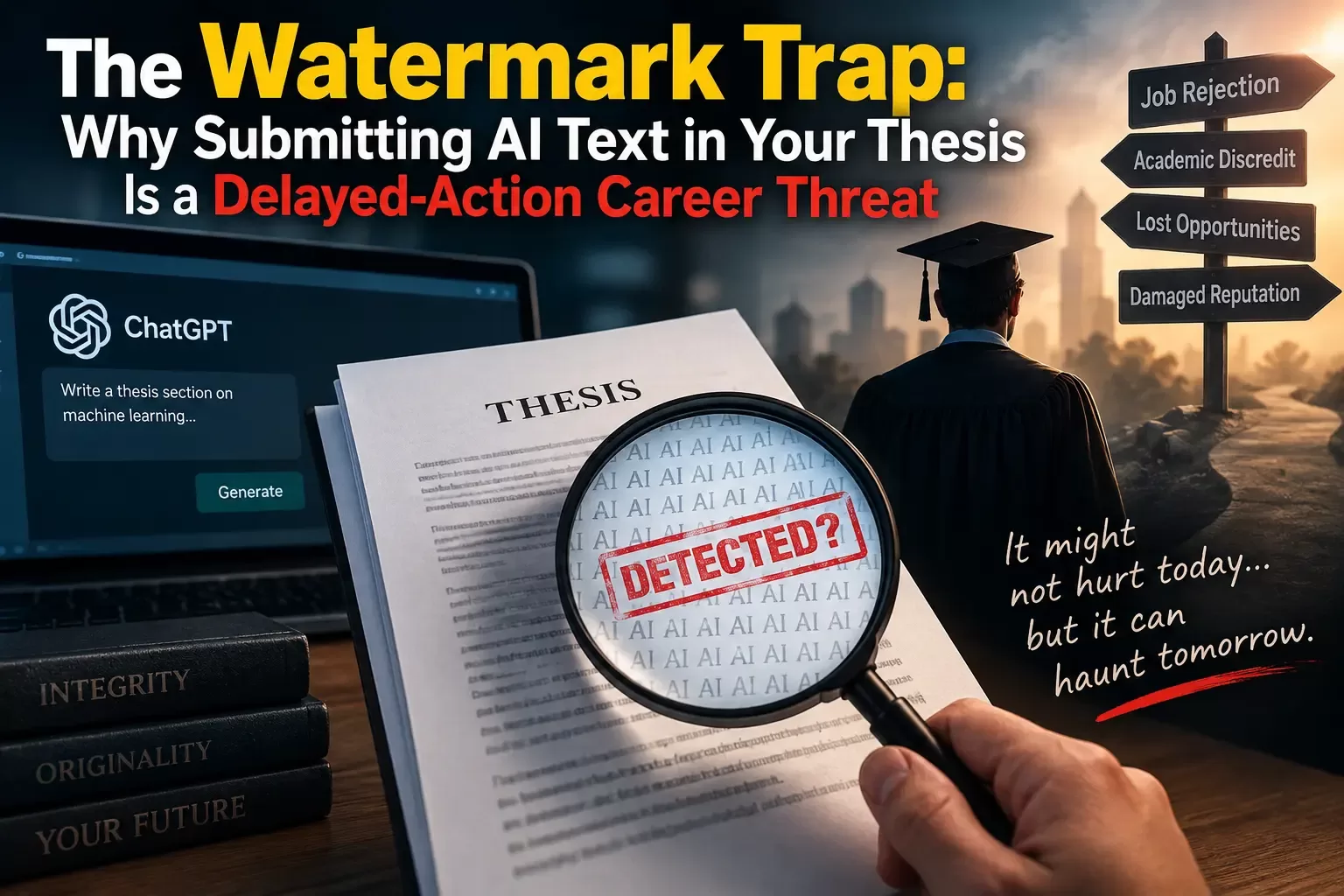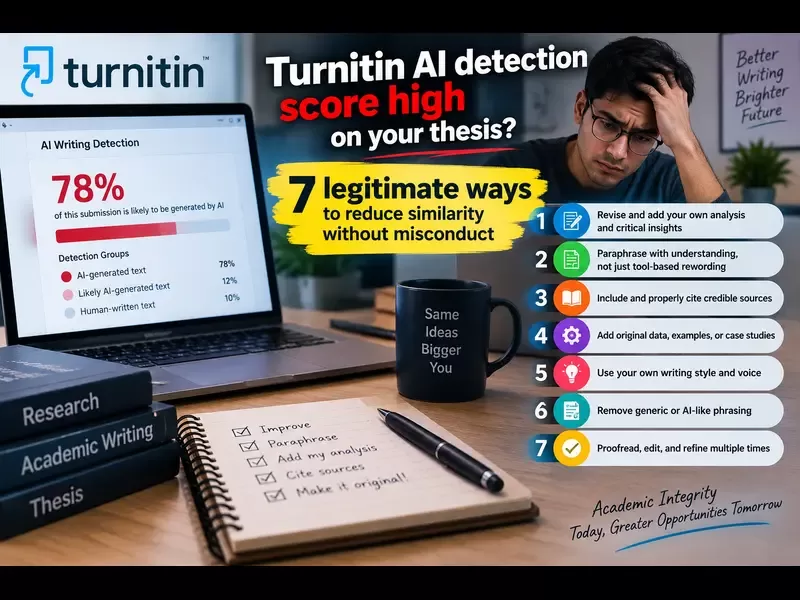
If your university run of Turnitin returned an AI score of 35% or 50% on chapters you researched and wrote yourself, you are not alone. Research advisory committees across universities are seeing false positives weekly. The issue stems from the mechanical nature of academic writing itself, which algorithms often misinterpret as machine generation.
Before you consider rewriting everything overnight or using online text-spinning tools, you need to understand why detection software targets academic prose and how to revise your manuscript so it clears review cleanly.
Why Turnitin flags genuine doctoral writing as AI
Turnitin does not compare your text against a database of past papers to find AI matches. Instead, its detector evaluates statistical probability using two metrics: perplexity and burstiness.
- Perplexity measures word predictability. Academic writing follows strict conventions. In an empirical methodology chapter, standard phrases like "data were collected using a structured questionnaire" have almost zero unpredictability. To an algorithm, predictable phrasing looks machine-generated.
- Burstiness measures sentence variety. Human writers naturally shift between short sentences and long, complex explanations. When writers try too hard to sound formal, they often produce five or six sentences in a row of roughly 25 words each. That mechanical rhythm is the primary trigger for an AI flag.
Do not use tools advertised as "undetectable AI" or automated rewriters. They replace standard terminology with unnatural synonyms and scramble sentence syntax. Examiners can spot spun text immediately, and presenting scrambled sentences as doctoral research carries far worse consequences than addressing an AI score directly with your supervisor.
7 practical ways to lower AI similarity in your thesis chapters
1. Break the monotonous sentence cadence
Open a flagged paragraph and count the words in each sentence. If you find five consecutive sentences between 20 and 28 words long, the paragraph will likely trigger an alert.
Vary the structure deliberately:
- Place a direct, ten-word statement after a thirty-word methodological explanation.
- Use semicolons to connect related observations rather than stringing together three separate sentences with identical beginnings.
- Read the passage aloud. If every sentence has the same tempo and cadence, rewrite two of them to sound more conversational.
2. Anchor arguments in your specific raw data
Language models generate summaries by averaging broad patterns from online data. They cannot describe what happened in your lab on a Tuesday afternoon or what an interviewee said during fieldwork.
Whenever a paragraph sounds generic, anchor it to your actual findings:
- Include your exact statistical values: degrees of freedom, effect sizes, exact response counts, and non-significant correlations.
- Describe field constraints, such as regional power cuts affecting equipment, missing survey batches, or seasonal sample variations.
- Highlight anomalies. AI tools summarize clean trends; real human datasets have outliers and messy variables.
3. Use an active, accountable scholarly voice
Traditional academic guidance taught researchers to avoid first-person pronouns completely. While that convention still holds in some engineering disciplines, relying exclusively on passive phrases like "it was noted that" or "observations were conducted" creates the exact impersonal tone models replicate.
Where your department allows, write directly: "We categorized the responses into four thematic brackets" or "The regression model indicates" rather than "It can be deduced from the resulting analysis that."
4. Remove formulaic transition templates
Certain transitional phrases appear in almost every AI-generated essay because language models rely on them to link disparate ideas. Review your text and cut the following stock phrases:
| Typical AI phrasing | Direct human alternative |
|---|---|
| "Furthermore, it is crucial to recognize that..." | "The survey data shows..." |
| "In the rapidly evolving landscape of..." | "Since 2022, microgrid deployment has..." |
| "This serves as a clear testament to..." | "These findings match the model proposed by..." |
| "Delving deeper into the findings..." | "A breakdown of the variance across cohorts shows..." |
5. Write multi-author debates rather than serial summaries
If your literature review lists one study per paragraph (Author A discovered X, Author B evaluated Y, Author C proposed Z), detectors treat the text as automated summary compilation.
Instead, show how studies conflict with one another within the same paragraph. For example:
"While Martinez (2022) found that distributed solar installations lowered grid volatility in urban districts, Chen and Rao (2024) observed the opposite in semi-rural networks where battery storage was absent."
Comparing two opposing papers in a single sentence requires synthesis and critical evaluation that automated tools rarely produce.
6. Verify every citation against the original document
One common reason software flags text is shallow citation density, where statements refer to widely quoted findings without referencing page numbers or experimental setups. Go back to your source PDFs:
- Quote specific instruments, scale reliabilities, or survey sample sizes directly from the original studies.
- Ensure the reference formatting follows standard departmental style, such as the guidelines in our APA 7th edition formatting guide.
- Remove secondary citations where you have not read the primary paper yourself.
7. Include a formal AI tool disclosure statement
Most universities do not prohibit using software for basic grammar checks, literature organization, or code formatting. What supervisors object to is undisclosed generation.
Add an explicit declaration in your dissertation front matter detailing:
- Which software you used (such as Grammarly for syntax proofreading or Zotero for reference management).
- How you used it (spelling checks, formatting, or script debugging).
- A direct statement confirming that all data collection, analytical choices, and interpretations are your own work.
What to do if your supervisor questions a false positive
If Turnitin shows a high percentage on work you wrote independently, do not panic and do not rewrite legitimate chapters in a hurry. You have records that prove authorship:
- Gather timestamped revision logs: Pull up the version history in Microsoft Word, Google Docs, or Overleaf. Showing a document that developed across months, with gradual paragraph additions and manual edits, is concrete evidence of authentic writing.
- Present primary research files: Bring your raw SPSS `.sav` files, R scripts, interview audio recordings, or handwritten laboratory notebooks to your meeting.
- Request a qualitative review: Ask your departmental committee to assess the draft on scholarly merit rather than relying solely on an automated percentage score.
Check your thesis for AI and plagiarism before your supervisor does
Do not wait for your university committee to run an official scan. Run your dissertation chapters through our dedicated AI plagiarism detector to identify flagged passages, review similarity scores, and resolve issues before final submission.